

You are using an out of date browser. It may not display this or other websites correctly.
You should upgrade or use an alternative browser.
You should upgrade or use an alternative browser.
6/2(2+1)=???
- Thread starter Cake
- Start date
i am the 101me. I am.
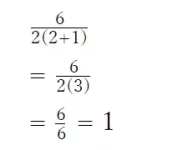
why are you replacing 2+1 with x? you only use a variable when the number is unknownThere's something wrong with this
Let's say we have 6/2(2+1).
We can replace the (2+1) with x while knowing x=3
Then we get 6/2x=9
Now we solve for x
6=18x
1/3=x
1/3=/=3
But if 6/2x=1
Then we get
6=2x
3=x
That is correct.
AAAAAAAAAAAAAAAAAAAAAAAAAAAAAAAAAAAAAAA
OK EVERYONE LISTEN TO ME.
To solve this, one has to consider priorities: first solve the parentheses, then multiplications and divisions. With multiple multiplications and divisions, there are different ways to go about this. Let's solve the parentheses then explore these ways.
6/2(2+1)
6/2(3)
Some people say that since parentheses have priority, at this point one must do 2*3 which results in 6/6. This isn't true. It's not the parentheses that have priority, it's the operations inside them that do. Once we have 6/2(3) that is the exact same as 6/2*3 and there are no more priorities here. Everyone saying that since parentheses have priorities 6/2(3) becomes 6/6 is on a special level of dumb.
With this being said, let's explore how to solve 6/2*3.
Way #1: solve the first operation, then take the result and use it for the second operation. This is according to PEMDAS/BODMAS, that states that if there is same precedence, operations must be solved left to right.
This way, we get:
6/2*3
3*3
=9.
For this first method, the result would be 9.
Way #2: consider this as a fraction, thus getting 6/(2*3). We have to solve the denominator, thus getting 6/6 which equals 1. This is according to PEMDAS/BODMAS the way it was used in 1917, that added a special extra rule: if there was a division, like l/r, then the part before the division sign would be the numerator and the part after would be the denominator.
However, this method is no longer in use; if mathematicians want to do something like this, they put the vertical fraction, with the numerator, a horizontal line under it, and the denominator under the line. This wasn't done in 1917 to save paper and use less space, and also it would've been easier to print. However, this method is now outdated.
CONCLUSION
The correct answer nowadays is 9. THIS IS NOT DEBATABLE since it has been approved by mathematicians who know more than all of you combined. Now please kindly be quiet and don't try to be mathematicians because you're failing badly. Thanks.
SOURCES
OK EVERYONE LISTEN TO ME.
To solve this, one has to consider priorities: first solve the parentheses, then multiplications and divisions. With multiple multiplications and divisions, there are different ways to go about this. Let's solve the parentheses then explore these ways.
6/2(2+1)
6/2(3)
Some people say that since parentheses have priority, at this point one must do 2*3 which results in 6/6. This isn't true. It's not the parentheses that have priority, it's the operations inside them that do. Once we have 6/2(3) that is the exact same as 6/2*3 and there are no more priorities here. Everyone saying that since parentheses have priorities 6/2(3) becomes 6/6 is on a special level of dumb.
With this being said, let's explore how to solve 6/2*3.
Way #1: solve the first operation, then take the result and use it for the second operation. This is according to PEMDAS/BODMAS, that states that if there is same precedence, operations must be solved left to right.
This way, we get:
6/2*3
3*3
=9.
For this first method, the result would be 9.
Way #2: consider this as a fraction, thus getting 6/(2*3). We have to solve the denominator, thus getting 6/6 which equals 1. This is according to PEMDAS/BODMAS the way it was used in 1917, that added a special extra rule: if there was a division, like l/r, then the part before the division sign would be the numerator and the part after would be the denominator.
However, this method is no longer in use; if mathematicians want to do something like this, they put the vertical fraction, with the numerator, a horizontal line under it, and the denominator under the line. This wasn't done in 1917 to save paper and use less space, and also it would've been easier to print. However, this method is now outdated.
CONCLUSION
The correct answer nowadays is 9. THIS IS NOT DEBATABLE since it has been approved by mathematicians who know more than all of you combined. Now please kindly be quiet and don't try to be mathematicians because you're failing badly. Thanks.
SOURCES
AAAAAAAAAAAAAAAAAAAAAAAAAAAAAAAAAAAAAAA
OK EVERYONE LISTEN TO ME.
To solve this, one has to consider priorities: first solve the parentheses, then multiplications and divisions. With multiple multiplications and divisions, there are different ways to go about this. Let's solve the parentheses then explore these ways.
6/2(2+1)
6/2(3)
Some people say that since parentheses have priority, at this point one must do 2*3 which results in 6/6. This isn't true. It's not the parentheses that have priority, it's the operations inside them that do. Once we have 6/2(3) that is the exact same as 6/2*3 and there are no more priorities here. Everyone saying that since parentheses have priorities 6/2(3) becomes 6/6 is on a special level of dumb.
With this being said, let's explore how to solve 6/2*3.
Way #1: solve the first operation, then take the result and use it for the second operation. This is according to PEMDAS/BODMAS, that states that if there is same precedence, operations must be solved left to right.
This way, we get:
6/2*3
3*3
=9.
For this first method, the result would be 9.
Way #2: consider this as a fraction, thus getting 6/(2*3). We have to solve the denominator, thus getting 6/6 which equals 1. This is according to PEMDAS/BODMAS the way it was used in 1917, that added a special extra rule: if there was a division, like l/r, then the part before the division sign would be the numerator and the part after would be the denominator.
However, this method is no longer in use; if mathematicians want to do something like this, they put the vertical fraction, with the numerator, a horizontal line under it, and the denominator under the line. This wasn't done in 1917 to save paper and use less space, and also it would've been easier to print. However, this method is now outdated.
CONCLUSION
The correct answer nowadays is 9. THIS IS NOT DEBATABLE since it has been approved by mathematicians who know more than all of you combined. Now please kindly be quiet and don't try to be mathematicians because you're failing badly. Thanks.
SOURCES
If you had to divide first, it would have been written like this
(6/2)(1+2)
Stop frying my guy 12st's brain and accept that the answer is 9,not 1No it's not, brackets go first no matter what, the brackets don't magically become a multiplication symbol, you just have to multiply to eliminate brackets. In 6/2(3) it becomes 1, if you have 6/2*3 you get a 9.
In the first one brackets come first, in the second one division comes first.
You're acting like someone attacking vaccines without giving any evidence.Stop frying my guy 12st's brain and accept that the answer is 9,not 1
Scroll up and you'll find ur evidence. Or just work it out ffsYou're acting like someone attacking vaccines without giving any evidence.
Well I've countered it many times, I don't know what you need to be convinced.Scroll up and you'll find ur evidence. Or just work it out ffs
Here's me repeating it AGAIN:
6/2(1+2)
6/2(3)
6/6
1
Brackets go first, even if it requires multiplication.
If you had to divide first, it would have been written like this
(6/2)(1+2)
I am seriously concerned for you.Brackets go first, even if it requires multiplication.
the operations inside brackets go first
we learned this in like second year of elementary school
You first have to deal with the brackets no matter what. 2(1+2) is one value just like 2x.I am seriously concerned for you.
the operations inside brackets go first
we learned this in like second year of elementary school
Wrong order:Correct order:
1+2 is 3
6/2 is 3
3x3 is 9
Wrong order:
1+2 is 3
2x3 is 6
6/6 is 1
Simples, now shush because you are so wrong that it's not even funny anymore
1+2 is 3
6/2 is 3
3x3 is 9
Correct order:
1+2 is 3
2(3) is 6
6/6 is 1
Simples, now shush because you are so wrong that it's not even funny anymore
honestly what the frick
According to the CURRENT PEMDAS/BODMAS, you solve first the OPERATIONS INSIDE OF PARENTHESES, then you solve the multiplications/divisions. And if two consequent operations have the same priority, then you solve them left to right. If you really still want to insist that this order is incorrect, going against current mathematical standards, then AT MOST you can say that the question is ambiguous. THE ANSWER IS NOT 1. It COULD be if you insist that it's ambiguous, going against current mathematical standards, but 9 will NEVER be the incorrect answer. NOW STOP PLEASE MY SANITY CAN'T TAKE THIS
According to the CURRENT PEMDAS/BODMAS, you solve first the OPERATIONS INSIDE OF PARENTHESES, then you solve the multiplications/divisions. And if two consequent operations have the same priority, then you solve them left to right. If you really still want to insist that this order is incorrect, going against current mathematical standards, then AT MOST you can say that the question is ambiguous. THE ANSWER IS NOT 1. It COULD be if you insist that it's ambiguous, going against current mathematical standards, but 9 will NEVER be the incorrect answer. NOW STOP PLEASE MY SANITY CAN'T TAKE THIS
They don't have the same priority, the brackets go first anyway no matter what, and even if they did have the same priority, 2(1+2) is ONE value, just like 2x. If you plug in 3 into 2x you get 2(3), so it still has the same value.honestly what the frick
According to the CURRENT PEMDAS/BODMAS, you solve first the OPERATIONS INSIDE OF PARENTHESES, then you solve the multiplications/divisions. And if two consequent operations have the same priority, then you solve them left to right. If you really still want to insist that this order is incorrect, going against current mathematical standards, then AT MOST you can say that the question is ambiguous. THE ANSWER IS NOT 1. It COULD be if you insist that it's ambiguous, going against current mathematical standards, but 9 will NEVER be the incorrect answer. NOW STOP PLEASE MY SANITY CAN'T TAKE THIS
No, if you needed to do brackets first, it would have been written 6/(2[2 + 1])
If you had to divide first, it would have been written like this
(6/2)(1+2)
@System64 pls approve math man
Share:
Off Topic