

You are using an out of date browser. It may not display this or other websites correctly.
You should upgrade or use an alternative browser.
You should upgrade or use an alternative browser.
6/2(2+1)=???
- Thread starter Cake
- Start date
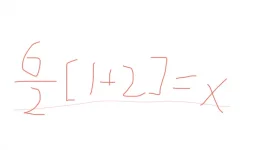
2x is still 2*x. Also, 2x is different to 2(3) because of how the question is posed. At most you can call this ambiguous. I literally brought proof relating to the current math standards, approved by mathematicians, you're bringing your theory and not backing it up with sources. The most you can achieve is that it's ambiguous, settle with that.They don't have the same priority, the brackets go first anyway no matter what, and even if they did have the same priority, 2(1+2) is ONE value, just like 2x. If you plug in 3 into 2x you get 2(3), so it still has the same value.
That is a very good way to make it no longer ambiguous.No, if you needed to do brackets first, it would have been written 6/(2[2 + 1])
@System64 pls approve math man
Perfect rebuttal to cake's theory.View attachment 23787
ITS LIKE THIS OHMYGOD PLEASE STOP
If it was that it would be written like thisView attachment 23787
ITS LIKE THIS OHMYGOD PLEASE STOP
(6/2)(1+2)
The division symbol has 1 meaning, divide everything on the left by everything on the right, the definition doesn't simply change like this.2x is still 2*x. Also, 2x is different to 2(3) because of how the question is posed. At most you can call this ambiguous. I literally brought proof relating to the current math standards, approved by mathematicians, you're bringing your theory and not backing it up with sources. The most you can achieve is that it's ambiguous, settle with that.
That is a very good way to make it no longer ambiguous.
Perfect rebuttal to cake's theory.
No, if it was like that it would stay the way it hecking is.If it was that it would be written like this
(6/2)(1+2)
The division symbol has 1 meaning, divide everything on the left by everything on the right, the definition doesn't simply change like this.
Why, because you don’t need parentheses for division when it’s already on the left.
Thanks for coming to my ted talk. All in all, it’s definitely not 1, and is ambiguous at best like sustem69 said.
that's why it's ambiguous, and that's why the new BEMDAS or whatever specifies that with the same priority, you solve the operations left to right.If it was that it would be written like this
(6/2)(1+2)
What you're thinking of is a fraction, not a division. There is quite a difference. What you're thinking of is the 1917 standard. 1917.The division symbol has 1 meaning, divide everything on the left by everything on the right, the definition doesn't simply change like this.
HAHHAGAGSGYSHSYAYAHHAHAHHAHAHAHAHHAHSHAHHAHAHAHAHHAHAHAHHAHAHAHHAHAHAHHAHAHAHAHHSHWGAHAHUAHAHAHAGAHHAHAHAHAHAHHAHAHHAHSHAJAHHAHAHABSHSHHSHAHAHAHAHAH **** MY LIFEWrong order:
1+2 is 3
6/2 is 3
3x3 is 9
Correct order:
1+2 is 3
2(3) is 6
6/6 is 1
Simples, now shush because you are so wrong that it's not even funny anymore
Order of operation gives you 9 (which in this case is the correct answer), however, due to different math rules down in history you would have gotten the answer 1. Not anymore today, but a while back.
Answer is therefore 9.
NEW METHOD:
6/2(2+1)
<=>6/2(3)
<=>6/2 * 3
<=>3 * 3
<=>9
OLD METHOD:
6/2(2+1)
<=>6/2(3)
<=>6/(2(3))
<=>6/6
<=>1
---------------------------------------------------------Answer is therefore 9.
staff above @Elementalish says nine hence is 9 thanks lock pls (not rly)Order of operation gives you 9 (which in this case is the correct answer), however, due to different math rules down in history you would have gotten the answer 1. Not anymore today, but a while back.
NEW METHOD:
6/2(2+1)
<=>
6/2(3)
<=>
6/2 * 3
<=>
3 * 3
<=>
9
OLD METHOD:
6/2(2+1)
<=>
6/2(3)
<=>
6/(2(3))
<=>
6/6
<=>
1
---------------------------------------------------------
Answer is therefore 9.
lumboc I love you you are very tallOrder of operation gives you 9 (which in this case is the correct answer), however, due to different math rules down in history you would have gotten the answer 1. Not anymore today, but a while back.
NEW METHOD:
6/2(2+1)
<=>
6/2(3)
<=>
6/2 * 3
<=>
3 * 3
<=>
9
OLD METHOD:
6/2(2+1)
<=>
6/2(3)
<=>
6/(2(3))
<=>
6/6
<=>
1
---------------------------------------------------------
Answer is therefore 9.
Math doesn't simply change, unless the definition of a whole symbol clearly changes, which it didn't so therefore the answer remains 1, the meaning remains, left side divided by the right side.Order of operation gives you 9 (which in this case is the correct answer), however, due to different math rules down in history you would have gotten the answer 1. Not anymore today, but a while back.
NEW METHOD:
6/2(2+1)
<=>
6/2(3)
<=>
6/2 * 3
<=>
3 * 3
<=>
9
OLD METHOD:
6/2(2+1)
<=>
6/2(3)
<=>
6/(2(3))
<=>
6/6
<=>
1
---------------------------------------------------------
Answer is therefore 9.
Math doesn't simply change, unless the definition of a whole symbol clearly changes, which it didn't so therefore the answer remains 1, the meaning remains, left side divided by the right side.
What Is 6÷2(1+2) = ? Mathematician Explains The Correct Answer – Mind Your Decisions
 mindyourdecisions.com
Math does change, to adapt for the evolution of technology. The rule of l/r was implemented as a way to put less parentheses and also save paper to avoid printing horizontal fractions, that take up space and are harder to write with a typewriter or the technology they had at the time. With the computer, this was no longer necessary, so this rule was removed. Also, it's not a question of whether math changes or not; it's not up to us to debate this, because math did change, and that is a fact. Furthermore, the definition of the symbol did change, as now it's just a division sign between a numerator and a denominator, instead of the entire left part and the entire right part.Math doesn't simply change, unless the definition of a whole symbol clearly changes, which it didn't so therefore the answer remains 1, the meaning remains, left side divided by the right side.
Basically 1+1=11 when you factor in the thermodynamics.1 + 1 = 11
please explain this on ted talk
thank you for coming to my second ted talk.
I honestly don't care what people answer on the math expression as it's soooo poorly written. Nobody would ever give you this question in a classroom unless they are trying to figure out your way of thinking. My personal opinion is that both solutions are correct, and if you want to you can even make this expression equal to 7. This depends on how you were taught this, however, there's still a correct way of doing it, and as someone who studies math academically, I can agree with this.Math does change, to adapt for the evolution of technology. The rule of l/r was implemented as a way to put less parentheses and also save paper to avoid printing horizontal fractions, that take up space and are harder to write with a typewriter or the technology they had at the time. With the computer, this was no longer necessary, so this rule was removed. Also, it's not a question of whether math changes or not; it's not up to us to debate this, because math did change, and that is a fact. Furthermore, the definition of the symbol did change, as now it's just a division sign between a numerator and a denominator, instead of the entire left part and the entire right part.
Math didn’t change. The process changed. Get with the times, smh my headMath doesn't simply change, unless the definition of a whole symbol clearly changes, which it didn't so therefore the answer remains 1, the meaning remains, left side divided by the right side.
Fractions > division symbolI honestly don't care what people answer on the math expression as it's soooo poorly written. Nobody would ever give you this question in a classroom unless they are trying to figure out your way of thinking. My personal opinion is that both solutions are correct, and if you want to you can even make this expression equal to 7. This depends on how you were taught this, however, there's still a correct way of doing it, and as someone who studies math academically, I can agree with this.
eh, fractions are division because it’s just like representing a decimal with its divisor and dividend, or denominator and numeratorFractions > division symbol
Fractions make it clear what you are dividing to everyoneeh, fractions are division because it’s just like representing a decimal with its divisor and dividend, or denominator and numerator
usually its obvious because most people follow the order of operations from after 1917 :/Fractions make it clear what you are dividing to everyone
The problem is this question is too vague. The question itself should've been either of these:Math doesn't simply change, unless the definition of a whole symbol clearly changes, which it didn't so therefore the answer remains 1, the meaning remains, left side divided by the right side.
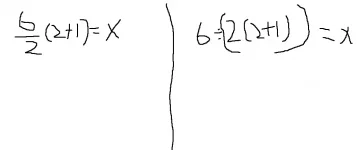
However flawed questions aside as everyone's been saying your method while not completely incorrect isn't what modern math standards define as correct.
Also you're right math doesn't simply change however since humans make math and define mathematical standards which are subject to error we can change what we know about math and fix errors that were once considered correct.
Share:
Off Topic